Golden Whip Stream: The Valley Floor Walk Through Zhangjiajie's Sandstone Forest
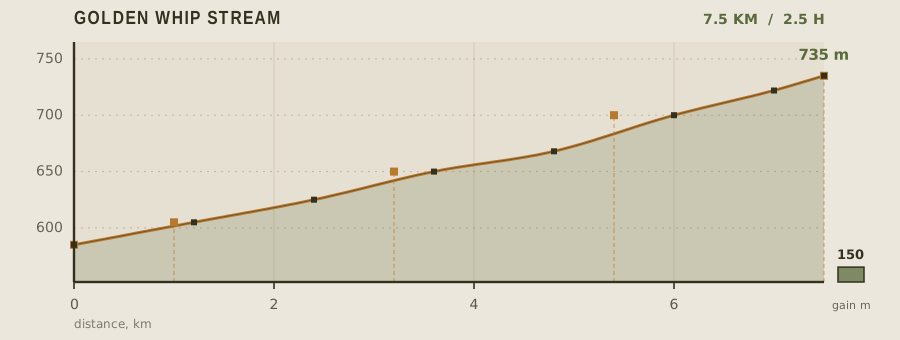
Almost everyone who comes to Zhangjiajie rides to the top of the sandstone pillars and looks down. The Golden Whip Stream walk does the opposite — it stays on the valley floor at around 600 m and walks 7.5 km beneath the same pillars, so you spend the whole route craning upward at rock walls that rise 300 to 400 m from the streambed. The gradient is gentle, the air is several degrees cooler than on the plateau, and it is the only major route in the park that is genuinely level walking.
- Distance
- 7.5km
- Elevation gain
- 150m
- Time
- 2.5h
- Grade
- Easyeasy
- Permit
- Permit required The Zhangjiajie National Forest Park entrance ticket covers four days, is sold by passport or ID, and must be shown at each gate.
- Season
- April to June and September to November; summer is humid and crowded
Geology and landscape
The trail never climbs above the stream bed, and that is why it works. Zhangjiajie's pillars are quartz sandstone: sediment laid down in the Devonian, compacted, then lifted and sliced by vertical joints that run the rock into blocks. Water did the rest. Golden Whip Stream, following the valley floor, has spent a long time sawing at the bases of those jointed blocks; winter freeze-thaw pries the cracks wider, slabs shear off, and the pillars retreat into the slender forms you see overhead. The landscape above and the ground below are two halves of one process. The floor itself tells you so. The path is flat — boardwalk, packed gravel, slick stone — and the stream braids past water-worn cobbles: hard quartz, darker siltstone and shale that weathered away faster, leaving the resistant sandstone standing. Where the valley widens, the current slows and drops its load; where it narrows, it runs fast between mossy banks. Above, the pillar walls are streaked and vegetated, often undercut at the base. You read this geology from the bottom up, which is the only way to grasp the full height of it.
Flora, fauna and seasons
The valley floor sits low enough to be genuinely subtropical, and the vegetation shows it. Broadleaf evergreens — laurels, oaks, members of the tea family — crowd the stream banks, laced with lianas and draped with mosses and ferns where the spray keeps things damp. Zhangjiajie is also a refuge for relict trees that vanished elsewhere in the ice ages: dove tree, ginkgo, Chinese yew, tulip tree. Most are subtle, and reward a slow walk. Beneath your feet, damp stone grows liverworts; above, the slopes run green until the sandstone pokes through. Wildlife is mostly heard before it is seen. Rhesus macaques patrol the picnic and stall areas, bold and quick-fingered; troops can turn aggressive if food appears. Muntjac, squirrels and civets keep to the undergrowth. The streams themselves are the stronghold of the Chinese giant salamander, a rare amphibian of clean, cold running water. Birds are constant — bulbuls, laughingthrushes, woodpeckers working the dead trunks. April to June brings new leaf, spring rain and rhododendrons in flower. September to November brings clear air and turning maples. Summer is humid and crowded; winter is quiet, cold and often icy underfoot.
History and culture
People have lived in these valleys far longer than they have walked them for pleasure. The Tujia are the area's best-known indigenous group, farming terraced ground and building timber stilt houses against the slopes; their hand-waving dance, brocade weaving and songs are still performed in villages around the park. Local tradition links the mountain's name to a Han-dynasty strategist said to have retired here, though the plainer reading is a Zhang family settlement. Either way, the peaks were sacred ground before they were scenery. The valley path itself is newer than it looks. What is now a boardwalk-and-flagstone route was, within living memory, a scatter of village tracks and stepping stones used by farmers and woodcutters between settlements. As the park became China's first national forest park and then a World Heritage site, those tracks were consolidated, bridging the stream where it ran too deep. A famous film later carried photographs of the pillars worldwide, and tourism followed: guesthouses, stalls, guided tours. The old culture survives in smaller registers — the smell of cured pork, tea sold from village houses, the terraced fields that still hold their shape. Walk quietly and you can still hear it.
Route description
Enter through the Forest Park gate and follow signs to the stream; the paved path begins about 200 m past the turnstiles. The route is unambiguous from there — it tracks the water the entire way, crossing on stone slabs and timber footbridges perhaps a dozen times. Golden Whip Rock stands at 1 km, the first of many signature pillars, and the stream then narrows between vertical walls through the middle section. Purple Grass Pool at 3.2 km is the widest open point with a deck and the main macaque concentration. Beyond 5 km the path threads the Water Winding Four Gates, then climbs gently to the Zhangjiajie Village terrace at 7.5 km, where you can catch the shuttle or the Bailong Elevator up to the plateau.
Water and resupply
The gate plaza has shops, boiled-water dispensers, and bottled water at park prices, which are about triple the town rate. Kiosks at Purple Grass Pool and the village terrace sell water and instant noodles in season but close by late afternoon and shut entirely in the low season. The stream itself runs clear and cold, but it drains a park that sees tens of thousands of visitors a day, so treat it as non-potable — boil for a full minute or run a 0.2 micron filter plus chemical treatment. In summer the humidity is the limiting factor; plan on a liter per person per two hours.
Recorded water points
- Forest Park Gate shops0 km
Bottled water, boiled water dispensers, and convenience kiosks at the gate plaza.
- Golden Whip Stream2 km
Clear and fast, but it flows through a heavily visited park; boil or filter before drinking.
- Purple Grass Pool stalls3.2 km
Seasonal kiosks selling bottled water and instant noodles, open roughly 8am to 5pm.
Bivouac and camping
Overnight camping inside the park is not permitted, and staying on the trails after the last shuttle is a serious problem because the gates close and the internal bus network stops. Legal accommodation is in the villages inside the park boundary — Zhangjiajie Village, Yuanjiajie, and Yangjiajie all have guesthouses reachable by shuttle — or in Wulingyuan town outside the gate, which has the widest range. All of it needs booking ahead in the May and October holidays, when the park runs at capacity.
Permit status
The Zhangjiajie National Forest Park entrance ticket covers four days, is sold by passport or ID, and must be shown at each gate.
Hazards and safety
The macaques are the most common cause of injury here. They are habituated, bold, and will bite; do not feed them, do not carry food in your hand, and keep bags zipped. Stone slabs along the stream are polished and stay wet after rain, so the fall risk is real even on level ground. Afternoon thunderstorms from June to August turn the stream into a fast muddy torrent within an hour, and the narrow gates section has no escape route — check the forecast and be out of that stretch by early afternoon. Summer heat and humidity cause more evacuations than any fall.
Read before you go
Distances, gain and water points here were recorded on the survey date. Confirm closures and current conditions with the managing agency, and leave your plan with someone staying behind.
Field conditions change. This survey is informational only and is not medical, navigational, or safety advice.